
What Level of English Am I? CEFR Levels Explained


Do you know your English level? Many people are not sure. Some think their English is better than it is. Many more think it is worse.
Knowing your real level helps you in many ways. You can choose the right class, the right book and the right exam. You save time and money. And you can see your progress as you learn.
In this guide, we explain the six CEFR levels in simple words. We show where Anglia exams fit. We also give tips for students, parents and teachers. At the end, you can find your own level with the Anglia Placement Test.
The six CEFR levels in simple words
CEFR means the Common European Framework of Reference for Languages. Schools, universities and employers around the world use it. It has six main levels, from A1 (beginner) to C2 (very advanced).
|
Level |
Name |
What you can do |
|---|---|---|
|
A1 |
Beginner |
Say hello, give your name and answer very simple questions. |
|
A2 |
Elementary |
Talk about your family, your home and your daily life. Buy things in a shop. |
|
B1 |
Intermediate |
Deal with most situations when you travel. Talk about your plans and give simple reasons. |
|
B2 |
Upper intermediate |
Speak with confidence on many topics. Understand the main ideas in films and news. |
|
C1 |
Advanced |
Use English easily for study and work. Understand long and difficult texts. |
|
C2 |
Proficient |
Understand almost everything you hear and read. Express ideas clearly and exactly. |
There is also a Pre-A1 level for young learners and complete beginners. Learners at this level know some words and very simple phrases.
Remember: most people do not have the same level in every skill. You might read at B1 but speak at A2. That is normal.
Daily Inspiration
Where do Anglia exams fit?
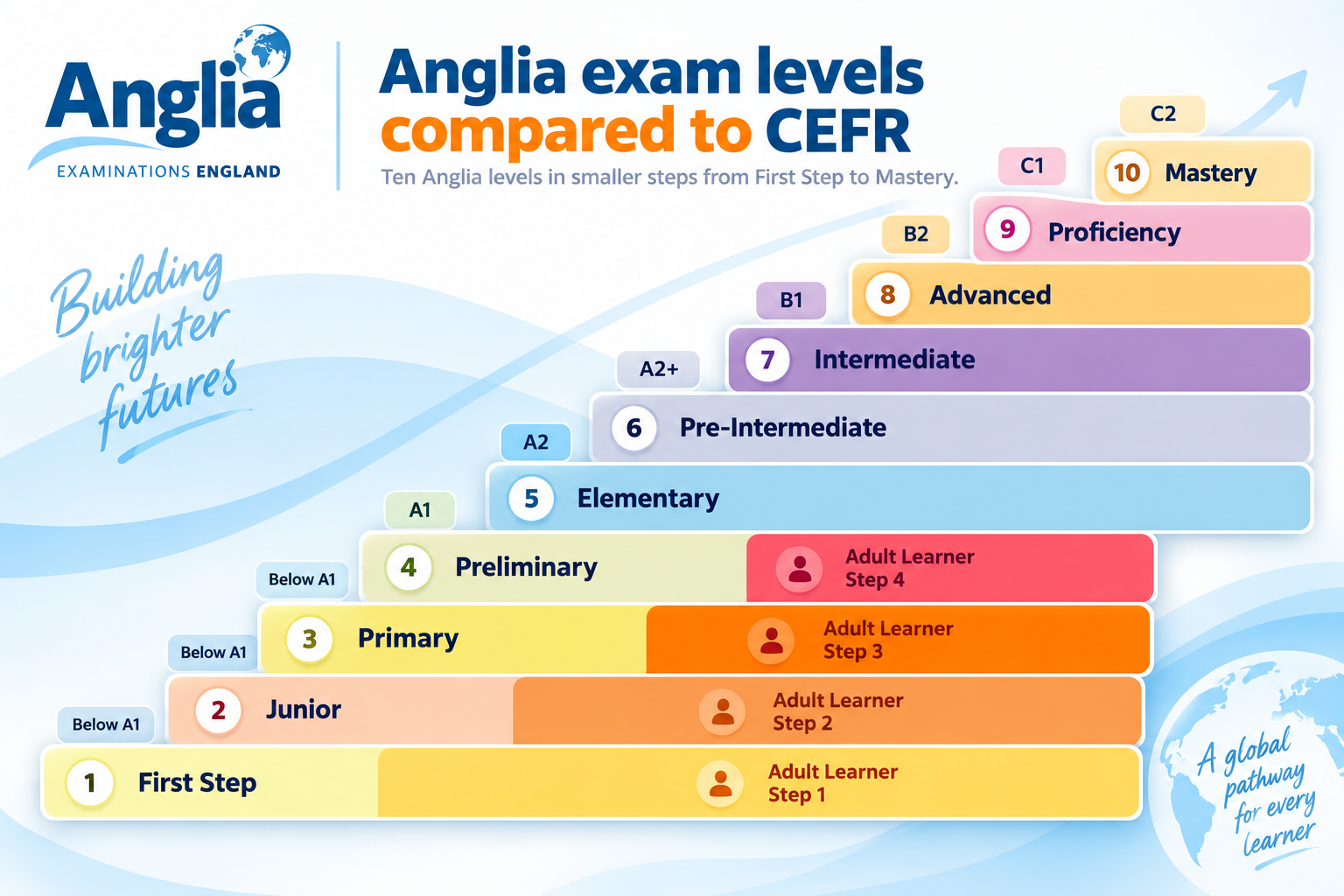
Anglia has ten General English exam levels. They go from Pre-A1 to C2, so there is a step for every learner, from young children to very advanced adults.
|
Anglia level |
CEFR level |
|---|---|
|
First Step |
Below A1 |
|
Junior |
Below A1 |
|
Primary |
Below A1 |
|
Preliminary |
A1 |
|
Elementary |
A2 |
|
Pre-Intermediate |
A2+ |
|
Intermediate |
B1 |
|
Advanced |
B2 |
|
Proficiency |
C1 |
|
Mastery |
C2 |
Because there are more Anglia levels than CEFR levels, the steps are smaller. Learners can move up one level at a time and feel success more often.
Why your level matters
For students
If your class is too easy, you get bored. If it is too difficult, you lose confidence. The right level keeps you interested and helps you learn faster.
Your level also helps you choose the right exam. When you pass an exam at your level, you get a certificate that shows what you can do. That can help you with school, university or work.
For parents
Is your child in the right English class? Here are some signs to look for:
- They say the lessons are boring or too easy.
- They feel worried or stressed before English lessons.
- Their homework takes much longer than other subjects.
- Their marks stay the same for a long time.
A placement test gives you a clear answer. It also helps you choose an exam that your child is ready for. Passing an exam at the right level builds confidence. Failing an exam that is too hard can do the opposite.
For teachers
At the start of the school year, you often meet a class with very different levels. Some students are ready for more. Others need extra help. This is one of the biggest challenges in language teaching.
A placement test can help you to:
- Make better groups. Put students with similar levels together, or plan mixed groups on purpose.
- Plan your lessons. See which skills need more work across the class, for example listening or grammar.
- Set clear goals. Give each student a realistic target for the end of the year.
- Show progress. Test again in the middle or at the end of the year. Share the results with parents and school leaders.
- Save time. Testing a whole class online is much faster than speaking to every student one by one.
Tip: share the CEFR table above with your students. When learners understand the levels, they can set their own goals and take more control of their learning.
How the Anglia Placement Test works
The Anglia Placement Test is an online test that shows your English level. You can take it on a computer, tablet or phone.
- Start the test. Go to angliaonline.com and click "Start the test". It takes about [X minutes].
- Answer the questions. There are [X] questions about [grammar, vocabulary, reading and listening: confirm]. Do your best and do not use a dictionary.
- Get your result. You see your CEFR level and the Anglia exam level that is right for you.
The test is [free / price: confirm].
Teachers: you can book the test for your whole class. You get the results for every student in one place. [Book a class test]
What to do after your result
Your result is the start, not the end. Here is what you can do next:
- Practise at your level. Use our free practice activities for your level. [link to practice resources]
- Look at the right exam. See what is in the Anglia exam for your level, with sample papers. [link to level page]
- Find a centre. Take your exam at an Anglia centre near you. [link to Find a centre on anglia.org]
- Test again later. Take the placement test again after a few months to see how much you have improved.
Frequently asked questions
- How accurate is an online English test? A good placement test gives a reliable picture of your level. It is not the same as a full exam, but it helps you choose the right class or exam with confidence.
- How long does it take to move up one CEFR level? It depends on the learner and the level. Lower levels are often faster. Higher levels need more time, because there is more to learn. Regular practice makes the biggest difference.
- Can children take the placement test? Yes! If they can use a mouse they can take the test- we are considering creating a second test especially for younger learners
- Is B2 good enough for university? Many universities ask for B2 or higher, but every university is different. Always check the entry rules of the course you want.
- Do I need to study before the test? No. The test shows your level today. Do not study for it and do not use help. That way, your result will be more accurate.
- What is the difference between a placement test and an exam? A placement test shows your level so you can plan your learning. An exam checks your skills in more detail and gives you an official certificate.