
Ten levels, six CEFR bands
what your English level actually means


You have taken an English test and you have a result. Perhaps it says B1. Perhaps it says Elementary. But what does that really mean, and what can you do with it?
Anglia has ten levels of General English. The Common European Framework of Reference, usually called the CEFR, has six bands. The two systems fit together neatly. This page shows you how they match, what you can do at each level, and which Anglia exam comes next.
Not sure of your level?
Take the free Anglia placement test. It takes about 35 minutes, works on a phone, tablet or computer, and you do not need an account.
What is the CEFR?
The CEFR is an international way to describe how well a person uses a language. The letters stand for the Common European Framework of Reference for Languages. The Council of Europe created it, and schools, employers and universities around the world now use it.
The important idea is simple. The CEFR does not count your mistakes. It describes what you can do. Can you order a meal? Can you write an email to a company? Can you follow a long talk about a subject you do not know well?
There are six bands, and they go up in pairs. A1 and A2 describe a basic user. B1 and B2 describe an independent user. C1 and C2 describe a proficient user.
The six CEFR bands in simple words
|
Band |
What you can usually do |
|---|---|
|
A1 |
You can say simple things about yourself and your family. You can ask and answer easy questions if the other person speaks slowly and helps you. |
|
A2 |
You can deal with everyday situations, such as shopping, travelling and short messages at work. You can describe your background in simple terms. |
|
B1 |
You can handle most situations when you travel. You can talk about your plans, hopes and opinions, and write simple connected text about familiar subjects. |
|
B2 |
You can talk to fluent speakers without strain on either side. You can read detailed texts in your own field and explain a point of view clearly. |
|
C1 |
You can use English comfortably in social life, at university and at work. You can understand long and demanding texts, including what is suggested but not said. |
|
C2 |
You can understand almost everything you read or hear. You can express small differences in meaning with precision, even in complicated situations. |
These descriptions are short versions of the official CEFR descriptors. Nobody is only one band in every skill, which is why your test result shows each skill on its own.
So why does Anglia have ten levels?
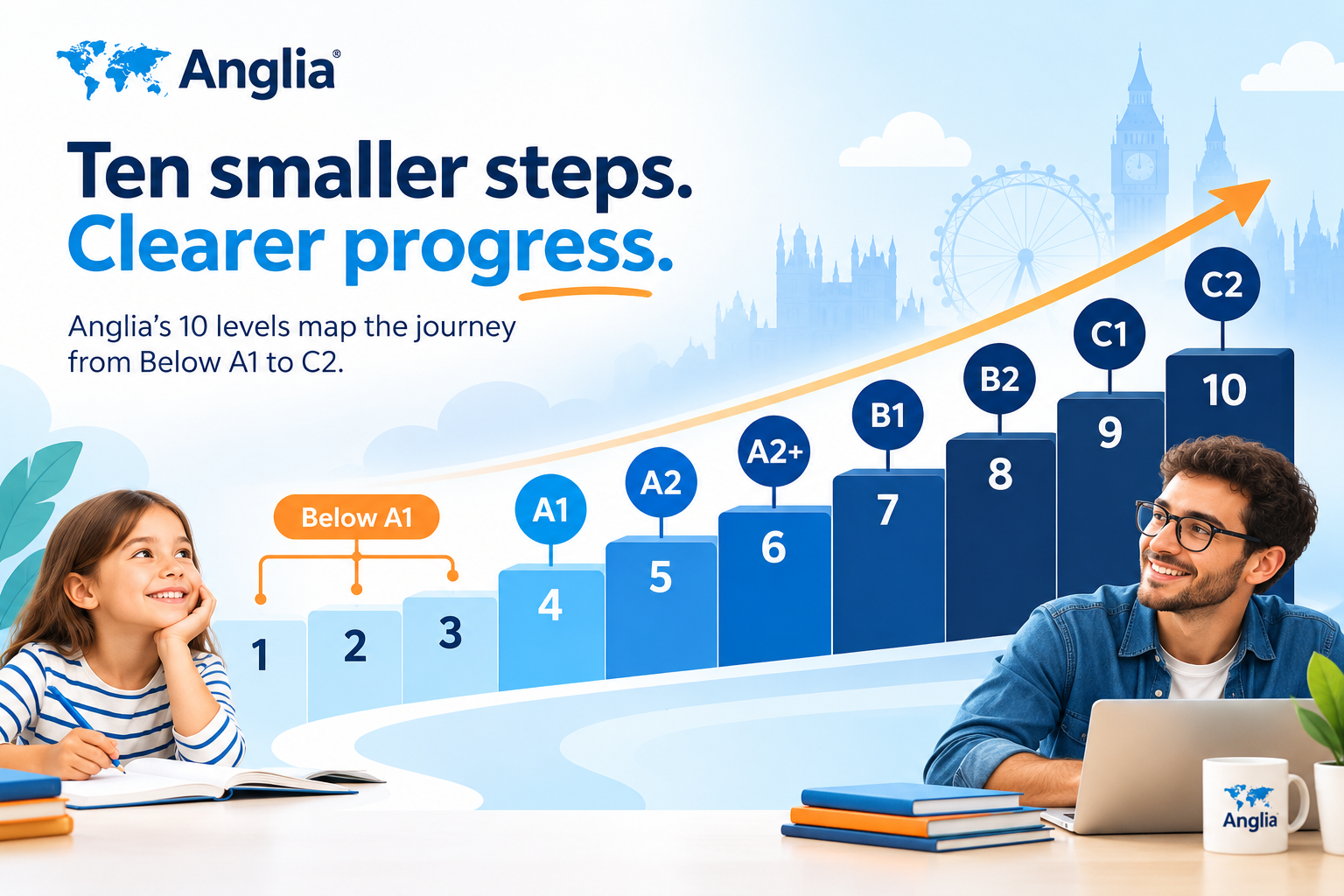
Because the six CEFR bands are wide. A learner can work for a year inside one band and still feel that nothing has changed.
Anglia divides the same journey into ten smaller steps. Each step has its own syllabus, its own Step To book and its own exam. Students take the next step when they are ready, see progress more often, and keep going.
The steps also start much earlier than the CEFR does. There is no minimum age for Anglia exams, and children as young as four take the first level. The first four levels also come in an Adult Learner version, so an adult beginner does not have to sit a children's paper.
The ten Anglia levels and their CEFR bands
|
Anglia level |
CEFR band |
|---|---|
|
1. First Step |
Below A1 |
|
2. Junior |
Below A1 |
|
3. Primary |
Below A1 |
|
4. Preliminary |
A1 |
|
5. Elementary |
A2 |
|
6. Pre-Intermediate |
A2+ |
|
7. Intermediate |
B1 |
|
8. Advanced |
B2 |
|
9. Proficiency |
C1 |
|
10. Masters |
C2 |
A2+ is not a seventh band. It is the stronger half of A2, and it marks the point where a learner is close to B1 but not yet there.
The top four levels are regulated qualifications in England. Anglia offers them with AIM Qualifications, so a pass at Intermediate, Advanced, Proficiency or Masters is also an Ofqual regulated ESOL International certificate at Entry 3, Level 1, Level 2 and Level 3. Candidates who pass at Masters also earn UCAS tariff points towards a university application in the United Kingdom.
What about the three levels before A1?
The CEFR begins at A1, but learning English begins earlier than that. First Step, Junior and Primary cover those first years.
At First Step a child does not have to write a single full word. They show what they understand in other ways, by matching a word to a picture, ticking what is right and colouring what they are asked to colour. Junior and Primary then add a little more reading, writing and listening at each step.
Sitting below A1 is not a weakness in these exams. It simply means the CEFR scale does not describe this early stage, while Anglia does.
What a level does not tell you
A placement result is a good starting point, not a final judgement. Three things are worth remembering.
- It is one day. Nerves, tiredness and a slow internet connection all affect a score.
- The free test covers grammar, vocabulary, reading and listening. It does not test speaking. It only tests writing if your teacher adds the writing task and marks it.
- Your skills are probably not level with each other. Many learners read better than they listen. Look at the breakdown by skill, not only at the single level on the front page.
Which Anglia exam should I enter?
Start with the level your result gives you, then think about time.
- If you are studying with a teacher and you have a term or more before the exam, the next level up is often the better target.
- If the exam is soon, or you are not studying regularly, enter at the level you were given.
- From Intermediate up to Masters, you need at least 40% in each of reading, writing and listening to pass. A strong reading score will not rescue a weak listening score, so check your breakdown before you choose.
Your teacher or your nearest Anglia centre can confirm the right choice for you.
Find your level for free
The Anglia placement test is free, and you do not need an account to take it. It takes about 35 minutes and works on a phone, a tablet or a computer.
When you finish you get your result, your CEFR band and a score for each skill. Your result is the Anglia level to work towards: the exam to prepare for next.
Teachers can do more. You can book the test for a whole class, give your students one code, watch who has finished, and see every result in one place as it arrives.
Teaching a class? Book the test for your students.
Common questions
What does CEFR stand for?
The Common European Framework of Reference for Languages. It is an international scale that describes what a person can do in a language, from A1 up to C2.
Is B1 a good level of English?
B1 is the first level of the independent user. At B1 you can travel, work and study in English in many everyday situations without help, and a lot of employers and colleges ask for it as a minimum.
Which Anglia level is B1? And B2?
Intermediate is B1 and Advanced is B2.
Are Anglia exams recognised?
Yes. Anglia has assessed English since 1993 and is based at Chichester College in England. The top four levels, from Intermediate to Masters, are regulated by Ofqual and offered with AIM Qualifications.
Can young children take the exams?
Yes. There is no minimum age, and children start at First Step from about four years old.
How long does it take to move up one level?
That depends on the learner, how many lessons a week they have and how much English they use outside class. Your teacher is the best person to ask.
Does the placement test cost anything?
No. It is free, for learners and for teachers.